§ TECH · 2 MIN READ
He Wouldn't Fly Until She Checked the Math
John Glenn would not orbit the Earth until Katherine Johnson checked the electronic computer's numbers by hand, because in 1962 her arithmetic was the standard the machine was measured against.

By Culture
THE SHORT VERSION
Katherine Johnson was a NASA mathematician who calculated the trajectory for Alan Shepard's 1961 flight, the first American in space. Before John Glenn orbited the Earth in 1962 he asked for Johnson to verify the electronic computer's numbers by hand before he would fly. She received the Presidential Medal of Freedom in 2015 and died in 2020 at 101.
In 1962, NASA had shiny new electronic computers, and John Glenn was about to trust one with his life. He had one condition before he would fly around the Earth. Get the girl, he said, to check the numbers.
The girl was Katherine Johnson, a mathematician from West Virginia who had been doing by hand what the machines were just learning to do.
The Human Computer
Johnson was a prodigy, in college at fifteen, done at eighteen. NASA's predecessor hired her into a pool of Black women mathematicians who were literally called computers: they computed. Flight paths, wind tunnel results, trajectories, all of it worked out on paper, precisely, because a wrong digit meant a lost pilot.
In 1961 she calculated the trajectory for Alan Shepard's flight, the first American in space. The path up and the path home: her arithmetic.
Checking the Machine
So when Glenn prepared to orbit the Earth and the numbers came from an electronic computer nobody fully trusted yet, he asked for Johnson to run the same calculations by hand. If her numbers matched the machine's, he would go. They matched. He went. He came home.
“The machine was checked against her, not the other way around.”
The Part a Kid Can Use
Her work was geometry and physics done carefully, which is to say it is teachable, and she said so constantly. She spent her later life telling students that math is a language rather than a talent, and that the people who get good at it are the people who keep showing up to it. She also kept asking to be in the room. The famous version of that story is that she asked to attend the engineers' briefings, was told women did not go, and asked whether there was a law against it. There was not, so she went.
Katherine Johnson received the Presidential Medal of Freedom in 2015 and passed in 2020 at 101 years old. She sits in the same line as Mark Dean, who built the machine, and Kunle Olukotun, who redesigned its brain. Every kid grinding through math homework should hear her story once: the numbers are a language, it is learnable, and it can take you off the planet.
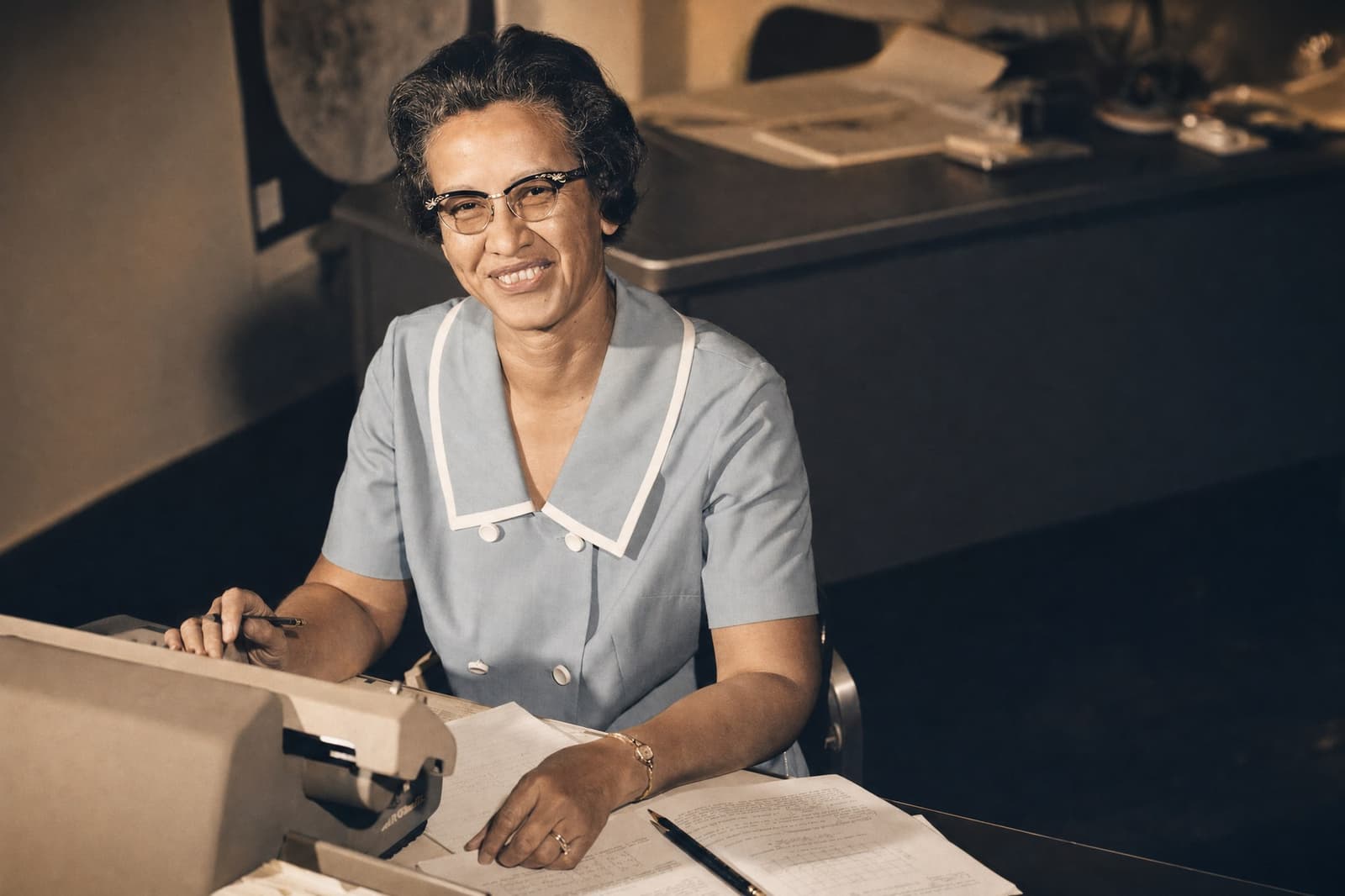
Cover photograph: Katherine Johnson at NASA, 1966. NASA photo, public domain. Edited by Culture.
- What did Katherine Johnson do at NASA?
- Katherine Johnson calculated flight paths and trajectories by hand, including the trajectory for Alan Shepard's 1961 flight, the first American in space. She worked in a pool of Black women mathematicians who were called human computers.
- Who were the human computers at NASA?
- The human computers were a pool of Black women mathematicians hired by NASA's predecessor. They worked out flight paths, wind tunnel results and trajectories on paper, and Katherine Johnson was one of them.
- Why did John Glenn ask for Katherine Johnson?
- In 1962 the numbers for John Glenn's orbital flight came from a new electronic computer that nobody fully trusted yet. Glenn said he would fly only if Katherine Johnson ran the same calculations by hand and they matched. They matched, and he flew.
- Where was Katherine Johnson from?
- Katherine Johnson was a mathematician from West Virginia. She was in college at fifteen and finished at eighteen.
- What did Katherine Johnson tell students about math?
- Katherine Johnson told students that math is a language rather than a talent, and that the people who get good at it are the ones who keep showing up to it.
- What awards did Katherine Johnson receive?
- Katherine Johnson received the Presidential Medal of Freedom in 2015, the highest civilian honor in the United States. She died in 2020 at the age of 101.